
I LOVE ICE CREAM.
I mean, who doesn’t?! If you answered “I don’t” to that question, then I don’t even know if we can be friends.
But seriously, I really love it. A couple weeks ago I got a midnight craving for ice cream. I was comfortably tucked under a blanket on the couch with my husband. We were both in our pajamas and neither of us felt like going out in the cold.

Figuring what the heck, I opened up the Instacart app on my phone and about 20 minutes later, two pints of our favorite Ben and Jerry’s flavors showed up on the doorstep. It might’ve been the most expensive ice cream I’ve ever purchased in my life, but being in full couch potato mode, it felt like the best splurge I ever made.
This got me thinking about the convenience of the digital age and how easy certain aspects of it have made my life. When the internet can give you ice cream, what else can it do?

The Internet has greatly evolved since its creation by the DOD’s Advanced Research Projects Agency (ARPA). Originally called ARPAnet, it began as a distributed network system that enabled the military and soon after, academic researchers, to look up and share information and messages digitally. Wider use of “the Net” began with the introduction of microprocessors, then personal computers (PCs). With the addition of fiber-optic cabling, the internet expanded to become a commodity available to almost everyone. There are still major disparities when it comes to the availability of the internet for some people, but that is a subject for a whole other blog post.
Since the birth of the Net to present day, we have seen a digital transformation like no other point in our history. The internet has converged with almost everything in our lives and has become a major part of our culture. We can use it to surf the web on our computers or laptops, run apps on our phones or tablets, and stream unlimited media content on our televisions. We rely on the internet for our jobs, our social interactions, our restaurant or movie choices, to control our tech, our homes, and our appliances. It seems that every product we buy is enabled with some sort of smart technology. It has even changed the way we shop.

Prior to the pandemic, the internet was already negatively impacting traditional brick and mortar stores. Amazon, the world’s largest online retailer, has seen it revenues skyrocket, while retail store locations have been reporting record losses in profits. With the onset of the pandemic, this trend has only grown.
If the culture of convenience and instant gratification is making online shopping put traditional stores out of business, are services like Instacart the answer?
Instacart had its humble beginnings in San Francisco in 2012, when CEO and founder Apoorva Mehta, created an app to offer an alternative way to grocery shop. He became Instacart’s first online shopper and customer, ordering and delivering groceries to himself to test the accuracy and efficiency of his creation. Instacart is now available in over 5,500 cities across the US and Canada and has expanded to over 30,000 stores, with some non-grocery retailers like Sephora, Best Buy, Dick’s Sporting Goods, and Family Dollar getting in on the action. Instacart also added pharmacy delivery to its list of services in 2019.
During the pandemic, the demand for virtual shopping and home delivery service grew exponentially, leading to Instacart hiring over 500,000 new shoppers since March 2020. And whereas Amazon Fresh customers have to wait 1-3 days for their groceries to be delivered, Instacart shoppers enjoy same-day delivery, sometimes in as fast as twenty minutes, depending on your order and location.
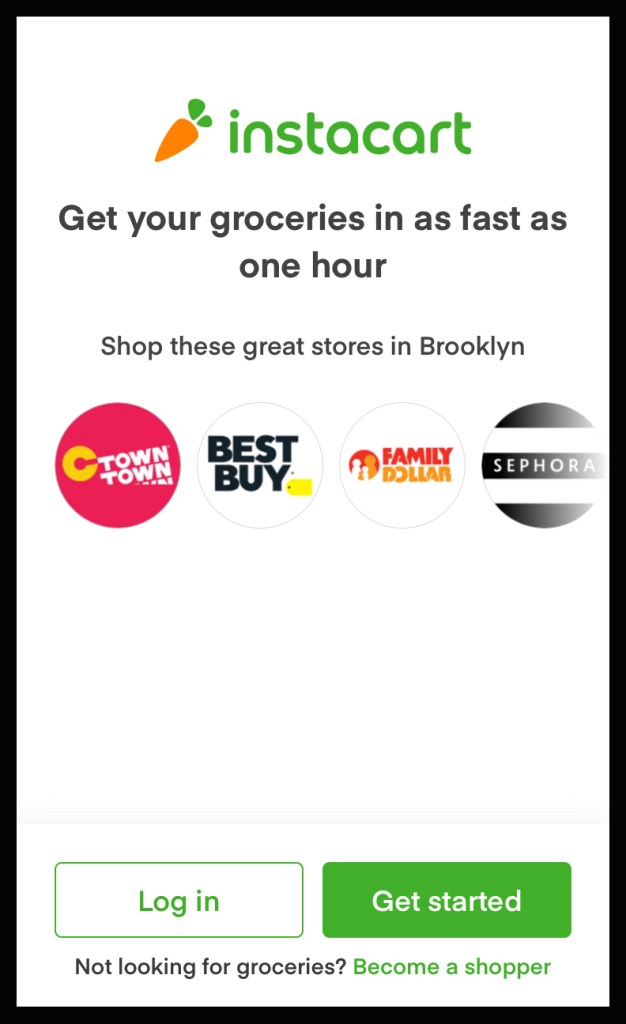
Instacart revolutionized shopping by bringing the internet to the grocery store. With plans to continue the expansion of service areas and retailers, Instacart will continue to change the way customers shop online. As innovations in technology become more mainstream and affordable, perhaps one day there will be a VR version of Instacart that brings you into the store virtually, where you can can pick out the products yourself via your shopper in real time.
Ordering anything you want from the internet has made things incredibly easy, and one might worry, to the point of causing people to become lazy. But when you are snuggled under a blanket with your feet up, eating ice cream delivered to you through an app while a robot vacuums your floors, those cares just melt away.

The following sources were cited in this post:
Campbell, Richard, et al. Media & Culture: Mass Communication in a Digital Age. 12th ed., Bedford/St. Martin’s, 2019, pp. 37-39.
Wang, Jennifer. “Instacart Founder Apoorva Mehta Becomes A Billionaire After New Funding Round.” Forbes, 17 June 2020, http://www.forbes.com/sites/jenniferwang/2020/06/17/instacart-founder-apoorva-mehta-becomes-a-billionaire/?sh=28c870da7e02. Accessed 31 Jan. 2021.
https://www.instacart.com/ and the Instacart App
 Lisa G Alford